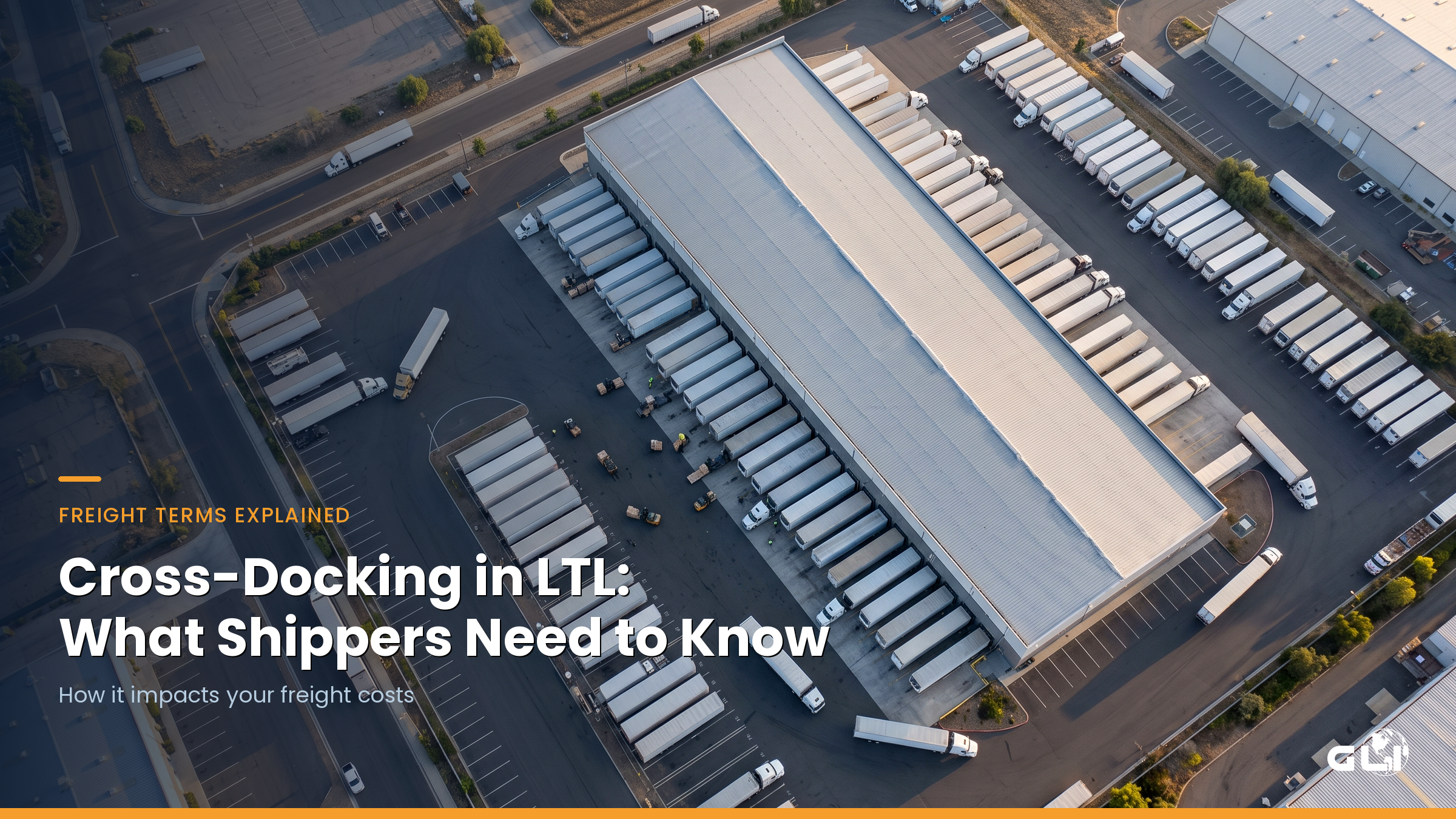
Cross-docking is when freight gets unloaded, sorted by destination, and reloaded onto another trailer without going into long-term storage. If you ship LTL, this isn't optional. It's the operational service you're paying for, and it happens on nearly every shipment you send, sometimes more than once.
For a mid-market manufacturer or distributor moving freight across multiple locations, understanding how cross-docking actually works helps you set realistic expectations for transit time and know when standard LTL isn't the right call for a specific shipment.
How Cross-Docking Works Inside the LTL Network
Every major LTL carrier runs a network of terminals, and cross-docking is how freight moves through them. Carriers know what's arriving well before it shows up, since that information lives in the carrier's system days in advance, not something a dock crew discovers when a truck pulls in. Here's what happens once your shipment reaches a terminal:
- Arrival and scanning. The inbound trailer gets unloaded and each shipment gets scanned at the dock.
- Sorting by destination. Freight gets grouped by where it's headed next.
- Consolidation. Your shipment gets combined with other freight moving the same direction.
- Line-haul. The combined load moves out on the next available trailer heading that way.
- Repeat as needed. Longer routes often pass through more than one terminal before final delivery.
That's the process. No pallet racking, no long-term storage, just enough handling to keep partial loads moving efficiently through the network.
Why This Happens on (Almost) Every LTL Shipment
LTL exists because most shipments don't fill an entire trailer on their own. Carriers solve that by combining partial loads from multiple customers into one full trailer, and that consolidation is exactly what a cross-dock does. Even a shipment moving five miles down the road typically goes to a terminal first and gets reloaded onto a different truck for final delivery. That's cross-docking, whether the distance is five miles or five hundred.
What Actually Causes Delays at the Dock
The common assumption is that a cross-dock delay means a shipment got lost in the shuffle. That's rarely what's actually happening. Most delays trace back to a few specific issues:
- ▸Trailer capacity mismatches. The freight volume moving through a terminal on a given day doesn't always match the trailer space available, so some freight waits for the next load.
- ▸Driver hours of service. A trailer can be fully loaded and ready to go, but if the driver assigned to that route has run out of legal drive hours, the trailer sits until a qualified driver is available.
- ▸Terminal backlogs. During high-volume periods, freight can sit at a terminal for several days before it gets line-hauled out, especially if that terminal is running behind on outbound capacity.
None of this means your carrier lost track of your shipment. It means the terminal network is working through normal capacity constraints, and it's worth understanding before you commit time-sensitive freight to a standard LTL lane.
A Realistic Example
Say you distribute HVAC parts with locations in three states. A compressor unit ships LTL from your Ohio warehouse to a contractor in Georgia. It doesn't go straight there. It gets cross-docked at a terminal in Kentucky and combined with other southbound freight before continuing. If that terminal is backed up, or the driver assigned to the next leg runs out of hours before departure, your shipment waits for the next available trailer and driver. You find out when the contractor calls asking why the delivery is late, not because anyone flagged it in advance.
Packaging and Palletizing Freight That Will Be Handled More Than Once
Because LTL freight typically gets unloaded and reloaded at least once, how you package and palletize a shipment matters more than it would for a direct truckload move. A few things worth checking before freight leaves your dock:
- ▸Use a pallet built for the actual weight and shape of the load, not just whatever's on hand. A pallet that shifts or breaks down during a transfer creates the damage claim you'll be filing later.
- ▸Shrink wrap and band the load so it holds together through multiple touches, not just the trip from your dock to the first terminal.
- ▸Use corner boards or edge protection on anything fragile or sharp-edged, since freight gets stacked and moved by forklift at every stop.
- ▸Label clearly on more than one side. A label visible from only one angle can get missed during a fast sort.
- ▸Flag anything that can't be stacked or tipped directly on the shipment itself, not just in the paperwork. Terminal staff moving fast don't always stop to check a bill of lading first.
Pre-Distribution vs. Post-Distribution Cross-Docking
Cross-docking splits into two approaches at the carrier's terminal, and it's worth knowing the difference even though you won't be the one choosing between them.
| Factor |
Pre-Distribution |
Post-Distribution |
| When the destination is decided |
Before the freight arrives at the dock |
After the freight arrives, based on demand |
| Time at the facility |
Shorter |
Longer |
| Best suited for |
Steady, predictable routes |
Freight that needs flexibility based on demand shifts |
| What it requires from the carrier |
Accurate advance planning |
Real-time sorting and tracking |
Here's the part that matters for you: you don't choose which method your carrier uses. The carrier's network decides that based on their own operation. You just experience the result, whether that's a fast transfer or a slower one.
LTL vs. a Dedicated Option: What You Actually Control
You don't get to choose whether your LTL shipment gets cross-docked. That's built into the service. What you do control is which mode you choose for a given shipment in the first place.
For most freight, standard LTL is the right call, and the cost savings are real. But for shipments that are fragile, high-value, or tied to a hard delivery deadline, the extra handling that comes with a multi-terminal move is worth weighing against a dedicated truckload option that skips the terminal network entirely. A few signs a dedicated option is worth the added cost:
- ▸The shipment is fragile enough that multiple touches meaningfully raise damage risk
- ▸The delivery window is tight enough that even a one-day terminal delay creates a real problem
- ▸The freight is high enough value that a claim, if something goes wrong, would be expensive to resolve
Managing the Parts of This You Can Control
You can't control how a carrier's terminal network runs. You can control which carriers you use, how their performance gets tracked, and whether damage claims and accessorial charges get challenged instead of quietly paid. That comes down to three things:
- Carrier selection based on data, not habit. Some carriers run tighter, more predictable networks than others. If you're not comparing on-time and damage rates across carriers, you're guessing.
- Freight bill audit. Accessorial charges and rate adjustments need someone checking them against the actual shipment, not just approving the invoice.
- Claims follow-through. A damage claim that sits unresolved for two months is money left on the table. Someone has to stay on it.
Cross-Docking in LTL: Frequently Asked Questions
Is cross-docking something I choose, or does it just happen with LTL shipments?
It just happens. Cross-docking is the operational service built into every LTL shipment, not an add-on you select or decline. Understanding how it works helps you know what to expect, but it isn't a decision point when you're booking a shipment.
How do I know if my freight is going through a cross-dock?
If you're shipping LTL, it is. Even a shipment traveling a short distance typically gets terminaled and reloaded onto a different trailer for final delivery, since that's how carriers consolidate partial loads efficiently.
Is cross-docking the reason my LTL shipments keep getting delayed?
It can be a factor, though usually not because your freight got lost in the shuffle. Trailer capacity limits, driver hours of service, and terminal backlogs are the more common causes. Tracking which carriers and lanes see this repeatedly is the best way to confirm it.
Should I use LTL, or is a dedicated truck a better fit for this shipment?
That depends on how fragile, time-sensitive, or high-value the freight is. Standard LTL works well for most shipments, but a dedicated or expedited option that skips the terminal network is often worth the added cost for freight that can't tolerate multiple touches or a tight delivery window. For more on how LTL networks route freight, the Council of Supply Chain Management Professionals maintains a full glossary of supply chain and logistics terms.
Maybe you're not sure whether a shipment should move as standard LTL or something more direct, or you're seeing repeat delays with the same carrier and can't tell if it's driver hours, terminal capacity, or something else entirely. Either way, that's exactly the kind of pattern GLI tracks across your full carrier mix. GLI manages carrier performance, audits freight bills, and follows claims through to resolution, so cross-docking and LTL handling stop being background risk you're absorbing without realizing it.
Ready to see how GLI handles cross-docking in LTL shipping for a business like yours? Get a free freight analysis. No commitment, no pressure. Just a clear look at where you stand and what's possible.

.png?width=400&name=hub-and-spoke-featured-image%20(1).png)